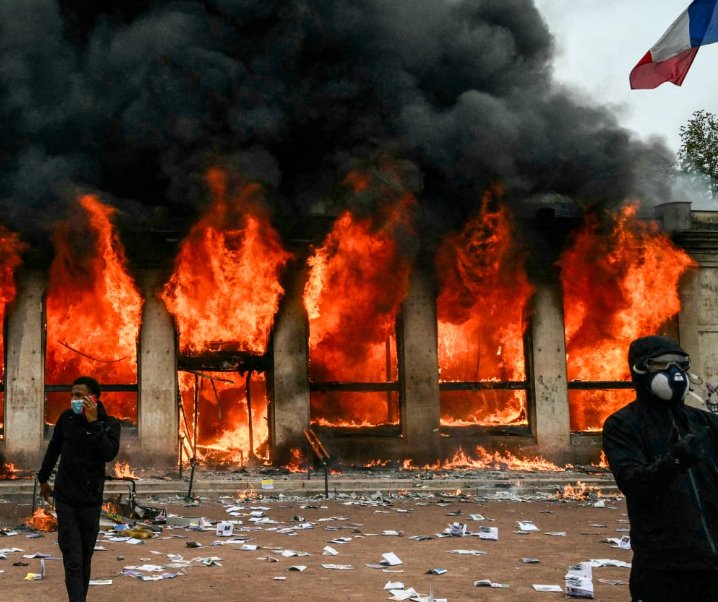
The revolution is there and here, for anyone that has the metabolism for it.
Author’s Note: A PDF is available at the bottom of this page.
Introduction
“The historical fact that bonfires have remained central to Halloween’s character for over two millennia speaks to something deeply desirable about gathering communally and burning away the old world together – a practice now rapidly spreading across the rest of the calendar. As the rare moments of social peace between upheavals in the U.S. become ever shorter and the fire of the Sabbat that once frequented Detroit sweeps through Ferguson, Baltimore, Milwaukee, and Charlotte, perhaps the ungovernable spirit of Halloween will not only return as a discrete, exceptionary moment in October, but, in the words of an old anarchist revolutionary [Bakunin], a holiday without beginning or end. October 31, all year round.”[1]
The fiery promises of October were not scattered when the Bolsheviks instituted military labor discipline in 20’, they were not sufficiently mutilated by the Purges of 36’ onwards, the Molotov-Ribbentrop Pact’s signing in 39’, nor when the Hungarians and Czechoslovaks were invaded in 56’ and 68’. Neither was October dismantled when the Polish State negotiated its way out of death in 70’, amidst China’s neoliberal pivot in the early 80s, or when the Berlin Wall fell in 89’. What seemed faint after the 20th century’s Socialist experiment was renewed by each of these experiences as an admission of managerial guilt, that capital as relation could not be sustained without coercion and brazen military force. Socialism was subject to its own ridicule then, as it will be now; we carry forward October with the designation of rebellion under every circumstance and class dictatorship.
This article is not quite about the socialists, the bureaucrats, or even the historical workers’ pitchforks, but rather the spirit of youthful insurrection this Hallows’ Eve. It is a time of year for hysteria and panic, always to murmur of plots and plannings which rip apart the very fabric of society. For your nuclear family’s own safety, please remember to heed the FBI’s warnings; the faint stench of anarchy in 2015, a clown insurrection in 2016.[2] “Now is the time of monsters”, where our greatest fears are but duplicated and shown back to us.
This fresh season of horror is defined by revulsion towards the youth precisely because the world fears what October represents, a cacophony of screams and empty judgements at those just beginning to form a social existence. Youth in America lost out in one-sided street battles last season, only to be outflanked by a growing number of French and Greeks, Belgians and Albanians, Indians and Spanish and Italians, the latter of which yell “Let’s do as in France!”[3] Some rich, some poor, with much of the latter–hailing from previous suburban anti-State movements–recognizing a critical contradiction in the greatest social formation in human history.[4] The youth movement may not be the revolution’s tipping point, but it has done the dirty work of holding up a mirror to capital and exposing the flaking mortality of the times.
What the elder petit-bourgeois and professionals cannot fathom is our embrace of death as means to live. Death is not an obstacle but a firm clasping of our collective unfutures: to embrace the death of capital as relation, to embrace what comes new after a moribund individualist society. Forever petrified by death, our patriarchal predecessors have been zombified into the desolate boredom of their individual prison cells. After their own gravedigging period, the children of the Baby Boom passed a world to the Xers that presented itself as immortal harmony. The Old World of soviets and gulags was dying, the New a facetious period of cosmic abundance. For this generation every death was offshored in private accounts. Every pittance enough to buy a car. They feared death so they paved away the vitality of nature, the prairies and the trees. Parking lots and spirals of single-family homes accompanied dried up rivers. All this a means to elongate the individual and upzone its elastic consciousness beyond any confines of death or space. To create new instincts and dehumanize in every capacity.
They lived a life we look at with contempt, not because of individual choices but because of a sheer lack of choice at all. To be young is to have glimpses of this: of the institutions you pass through clawing away at what remains of your imagination, and of a social life lived behind commodities which wreck your nervous system to the precipice of lifelong medicating. To whittle down “career prospects” in a labor market increasingly lacking reliance upon itself. We see, if only for a moment, that the lonely body is a cruel confines, a means to smash October. And the head of the household can only remain such for so long. It must reproduce and seek others, giving the youth an eternal choice between social death and spiritless life.
So between October and the rest of capitalist existence, which one will swallow us whole? Much of Europe’s offspring shares with its international brethren a desire for change, yet we would not be the first–nor the last–to address that change can be instituted. Our elders carry the banner of change, they have changed everything beyond recognition. Thus, the insurrection is a mass confusion. Setting demands–the mark of so-called maturity–leaves it to moribund life, where only after a decade do we realize Mélenchon’s regretful smiles and bumbling public appearances are more violent than any police charge. What is the difference between a dream and a nightmare?
The choices the movement faces, and how it embellishes its class character, must be defined by the spirit of October and Hallows’ Eve. That is, to commit the sacrilege of burning alive the Old World. It is not a period of unrest, because the revolution is not a penultimate clash between lines of cops and revolutionary youth. It is not buying time for a softer sleep, because the revolution is not a dream. It is a thousand fires and ten thousand more attacks upon what is unspoken, what is allowed to uniformly exist and mediate: the State, yes, but furthermore our social lives. The masked youths are the transcendent Party, not the relics of the last century–including those young and alike–whom desire nothing more than a spike in their poll ratings. With each social movement the bourgeois cliches expose themselves to blinding truths yet: this generation may just have the last sparkle in its eyes, but with it is bringing a resurgence of the communist movement.
Glimpses of Cliché
The reformation of the school is the sanctification of its clock.
“Watching young students and workers marching behind their red banners as if they were setting off to conquer the world, middle-aged Communists cannot help thinking, with nostalgia or with rage, about their own youth. Their leaders cannot help wondering whether this new wave will not invade their own territory as they themselves once invaded the territory of their social-democratic predecessors.” – Daniel Singer[5]
For most, the crisis in France clearly echoes that of May 68’. This is absurdly abbreviated by both the duplicity of battles across Europe, and the sheer scope in France alone: “More arrests have been made in the last ten days than during [all of] May 1968 — almost 90% of whom have been minors.”[6] Just as the students in 68’ had stormed forward in their rebellion and attempted to initiate strong class alliances with the workers, we see the same with the high schoolers’ ties with university students, professional educators, firefighters, and various union locals. Many meaningful bonds have been made with the youth’s predecessors, just as their fathers did with their prior mantle.
The cliché, then, is rather the role of politics. We know modern social life has never escaped this. A bold and parental left-wing of capital–the politicians and union bureaucrats with their professional support apparatus–has made displays to hone in on the youth’s energy, placed limits on what is socially acceptable, and pretend to have succumbed to enamoration of new youth so they can bottle it up. (GRC, 2026) Less cunning than fearful, the capitalist’s progressive front is dated and precisely aware of the fact. Yet their arguments are impenetrable for they established the mechanisms on which all arguments are made.
Generational politics subsumes participatory classes in a continual “Great Replacement”, filtering out the dead for the born. Every generation another flash of life dimmed and sullied away by the social relation, we cannot help but produce these eras of the politic. A new crisis, a new reaction, a new crisis, a new reaction. Unable to offer a significant positivist reinforcement, at the end of its lifespan reaction feebly grasps at the immaterial one last time, attempting to align with forces it no longer recognizes, and forces that no longer respect the reaction’s place in history. In 68’ the French Communist Party was the great cliche of this sort, a perfect relic on its last legs before faltering out into antiquity some time later. In 26’ France Unbowed is but a beheaded PCF with less faux-unity and positivist strength. The reborn October is able to take advantage of this fact, that the totalizing Party is dead, and capital’s left-wing cannot move without grand coalitions across varying social stratospheres.
Whether the youth movement faces off against this era’s reaction and reorganization is not exactly the question: as long as capital exists, such a circular phase is guaranteed to bake itself onto questions of social cohesion. We know it will be here, as it was to serve as a parody of black liberation in 20’ and of heroic individualist sacrifice in 25’.[7] History can only be so clever in its repetitive imagination. To break the cycle is to resist what it provides in favor of what we offer. Thus the Party of Insurrection must smash its own clichés, searching beyond the desperation of youthful poverty.
To do this is to reorient ourselves against a returning enemy in favor of our respective social lives. The cliché is not just eminent in the angry youths of the banlieue, but primarily in the return to school in light of pivots to the State’s orientation. Brief expansions in a mythical emergency budget massaged by newly sworn-in charlatans. Demands for the share of powers and political respect, the student condition is granted.
What we are saying extends beyond the proletarian condition, toward the vagabond-inducing act of dispossession itself. What must be said is that the student is dispossessed at the bottom of a social vacuum. They and we should not demand power nor respect: What is there to respect about our blind servitude? No, our contempt for the State must likewise materialize in the contempt for the remainder of life outside of it, for the procuring of artificial needs and expansions of labor power. Students at the bottom naturally want to float to the top as easily as our predecessors, but to do that in this social climate is to walk blindfolded with Christ. Leave these aspirations to the few remaining entrepreneurs among us, and burn the rest of it to the ground.
Over a year ago, we published ‘The Student Psyche in Political Crisis’, a project to address the calling cards and cliches of the Palestinian Solidarity Movement in America. Our premise was simple: Students needed to venture beyond the confines of their private prison, the university. The liberation of humanity could only be congruent with the abolition of such institutions, and their reform would likewise spell doom for the local populations their domains inhabited. While we still hold this position–the abolition of the university and academic institutions–it is important to elaborate on the nature of the student-proletarian relation. Students are fledgling proletarians undergoing remarkably hostile conditions. Each and every demand they make is illustrative of the lack of direction they maintain over their lives. It is economistic, allocative, obstructive to the other realms of accumulation and therefore at odds with much of the bourgeoisie. But it is just that: at odds. The student condition is a necessary element of capitalist society in every means of immediate and long-term employment, as the young enter a conveyor belt of part-time service oriented works until they appreciate their labor power (and get a little bit of luck). Better schools perhaps facilitate this better, helping students expand their mental capacities and acquire more tenable employment. Or maybe they facilitate it worse, the market doesn’t magically adjust to an increase in professionals, and leaves accomplished graduates unemployed anyway. Either way funnels the producers of society into reproducers; it does not genuinely matter how liberating and accepting the standard of education is. For proletarian self-abolition, we need student self-abolition. Students willingly lodging their hands in the machinery of capital. For the institution of education? No, but for the expansion of education into all spheres of life.
This reads as largely critical of the current youth uprisings, but the critique exists precisely because of the immense merits the youths have illustrated. They have tested the sanctity of the State across Europe and around the world. But further, the young will need to rip apart the sanctity of their own identity. The driver of the luster of youth is its very valorization, as a massive life force to shred and burn. A deposit of yet increasingly efficient labor value. At the heart of the ongoing struggles, this is what is really sacred. In the spirit of Marx, the abolition of the university entails that we are all academics, cooks, plumbers and construction workers. Our rightful disgust of the preceding generations’ empty, bountiful lives must include the admonishment of our class character. At that, we can do nothing but welcome the spirit of a new October.
Hallows’ Eve as Parody & Testament to a New October
“Within this new context of manufactured stranger danger, “Satanic Panic,” urban abandonment, economic stagnation, generalized poverty, anti-Blackness, and Black rage… the rebellious spirit of Halloween once again returned to animate and rechristen the holiday’s eve: Devil’s Night, “the day Detroit sets itself on fire”… With over 297 arsons on October 30th alone, 1984’s Halloween season set the high water mark for destruction with “the worst fire scenes I’ve seen since the riots of 1967,” according to a former Detroit Fire Department chief. His statement is notable because within it is a glimpse of authorities’ conceptual framework for viewing Devil’s Night – not as an isolated incident, but rather as an aftershock of The Great Rebellion that rivaled its destruction and, therefore, could be eligible for the same levels of counterinsurgency.” (Anonymous, 2021)
In America’s past, Halloween was to whisper doubt of the sacred, then blunt its own edge. Class anxieties were abound, for it was a suspension of the ethical in which previous agreements between the classes were moot. The State taken as seriously as “It’s the Great Pumpkin”, the communal flames were a totality, whether through a bonfire or a burned out car. For now, it is a power of raw parody, subverting our dreams of social decay with a playful forgetfulness of the night before. Capital has valorized fears about itself and its draconian regime, flaunting its own opulence with the indisputable beauty of gore and commercial violence. Indie films and cheap costumes adorned complete the bourgeois festivity of individual imprisonment, of severing all ties beyond a remote, fantastical individual reality. Everything from the commercial to a mixer, horror to children’s special eclipses what might become of us on our couches. Then you grow up and the nuclear family seizes upon the rest of this domain, as it has reigned for so many years. Sealed aspirations only to unravel when it is again the child’s turn to revel in mystique and fantasy.
These parodies reflect our desire for a youthful connection beyond our years, to communicate with the spirits of our past selves. The testament in this capitalist unfreedom is the habitual nature of the Event: every year until we rot, we wait for the festivities to mask our undying revulsion at the “natural” world around us, and to create something new. Sometimes this can only be done with polyester and cotton, but it does not detract from the fledgling desire to break from the social formation. In the vein of “October 31, all year round,” we already have it, but it is spectacular and emblematic of the bourgeoisie’s unceasing willpower. It can be found in the shopping aisles of every supermarket, a dizzying array of pagan and Catholic universes waiting to be tapped into at the onset of every existential change in season. Halloween in August. Christmas in October. Easter in February. Summer in April, then back to school in July. Degrees of separation enforce this holiday without beginning or end, a genuine image of satisfaction we know we will never touch. We indeed have Hallows’ Eve year round, but it is not the one we want. It is hardly the one we can’t imagine better. It is the yearly parsing through of life, through crisis, clinging onto new cycles of reaction like the old guard which stymies the youth revolts. Each reaction–the social-democrats, then the PCF, and now the rabid and fierce LFI–an attempt to turn the horror up, make the colors a hue brighter, and funnel more sugary corn syrup into the purveyor’s mouth until they can no longer breathe. So they simply don’t, choking away in the darkness of sounds and screens.
The difference between the binary of Octobers is the price of sugar: access to mass-spectacular sweetness is the prelude to revolutionary aspiration. How else would the advanced capitalist subjects fill their void, forgo revolution for lost memories of youth and wide possibilities? Every single angle of this holiday Utopia, this cosmopolitan worldwide Halloween is for sale. So commodified that it has begun auctioning off its own limbs, in preparation for the next great firesale in the business cycle of capital. The American imperialists inadvertently attack capital by going to war with Iran, raising oil prices and the opportunity cost of remaining subservient to it. Then it is Brazil’s pivots to ethanol over sweetener in midst of weather crises and the rising costs of fuel–as much as it is the political struggle–which implicates the longevity of the month’s insurgency.[8] With this our means of suffocation doubles its exchange value and rises higher still, apparently 71%, the reactionaries tout.[9] We no longer can play the same games we taught ourselves to maintain obedience. The old guard can no longer quell or manage, we and soon they will know it. A relatively dispossessed generation of recent times, then, is just another hammer on the nail of a coffin. We are bashed for degeneracy and not drinking enough. Landlords and real estate hubs wonder why we don’t live alone in boxy, luxury lofts. Social scientists and psychologists are contracted out, to study our peculiar ways to misguided industrialists and executives, only to affirm in an embarrassing flurry of studies that there is nothing there at all. Nothing but the spoiled, impatient generation who no longer dreams of toiling in a climate apocalypse, to meet a mere fraction of the expectations of spectacle, of capital’s reflection. We will never have enough, even for those of us whose bellies are full. As long as we cannot afford Brazil’s sugar or the Ivory Coast’s cocoa beans, October ceases to promise a route of sedation. Thus we arrive at the clamor of today, where we can only be sure of the following. Elections will be held. Ministers will be pulled, swapped out for charismatic new faces. The “Alt-Right” will make strides across the West, while the justification to ally with the remaining bourgeois gains ground. It’s all hell, all holiday cliche on top of a sea of bodies.
This being said. Even for a moment? What is rational is smashed. The ethical is superstitious. Youths have taken their swords to reorganization as fledgling workers resisting integration. Even the propertied and pensioners see merit, will stand between the police line and the youths. It is here we see the remaining kernel of Halloween’s nascent spirit, in the Celtic pagan festival of Samhain:
“In Celtic lore, it marked the boundary between summer and winter, light and darkness. In this respect, Samhain can be seen as a threshold, or what anthropologists would call a liminal festival. It was a moment of ritual transition and altered states. […] It represented a time out of time, a brief interval ‘when the normal order of the universe is suspended’ and ‘charged with a peculiar preternatural energy.”[10]
Capital, in refuge from its own mediation, has created supernatural images which the new generations can no longer accept as bounty, only reflection. The very tragedy it mediates thus becomes what its own images bear: poverty, starvation, endless haunting by the supernatural and the immaterial. Everything and anyone with means to end the horror–the lycee, the nuclear family, the benevolent State–is caricaturized as impotent. Thus it becomes impotent in the eyes of the purveyor. And what else? It has dialed the blood up to inducing psychosis, where we must outbid our own morbid angst for a more hellish reality. Then it is no wonder then that the bourgeois decade has been plagued with youthful obstruction: the spectacle is becoming a parody of itself unrecognizable to us. In American media culture of the 2000s and even early 10s, large homes and a steady job were a sign of existentialist dread. Films piled up to the brim of the last decade, with protagonists decidedly impoverished by their own mediation between life and death. The procuring of needs was seen as supplemental to deeper meaning, a pension a dry eye. Now, those same human stories of old don’t equate! There simply aren’t enough bedrooms and pensions to go around. And the European affair is just a reverberation of this phenomenon, where student/youth hybrids have already clashed with class society in Bangladesh and Nepal, Morocco and Madagascar, and so on. These youth revolts may have been swallowed up, many battles lost, but they mark a significant shift nonetheless.
The New October is not a dream of transcendence, but what is transcendent now. Every struggle that is whisked away to safe confines cannot resist this fact.
Youths Against Time
“Remunerated joy, weekends off or annual holidays paid by the boss is like paying to make love. It seems the same but there is something lacking…We work all the year round to have the ‘joy’ of holidays. When these come round we feel ‘obliged’ to ‘enjoy’ the fact that we are on holiday. A form of torture like any other. The same goes for Sundays. A dreadful day. The rarefaction of the illusion of free time shows us the emptiness of the mercantile spectacle we are living in.”
– Alfredo M. Bonanno[11]
The revolution is not the summation of a street battle, but what happens afterward. “Remunerated joy” is the sacred threat to another uprising, as time-value above, so below. Yet even in spite of this, every blockade and building seizure, every arson and firecracker fight, is a celebration of the death of the Old World. Our dreams are no longer the grounds on which the contradictions mount, but alive in this long, tortuous social death. Whether they amount to communist measures, time will tell. But yet again the communist movement is alive.
Citations
- Anonymous. (2021, October 31). The Devil’s Night: On the Ungovernable Spirit of Halloween. Ill Will. https://illwill.com/devils-night
- CBS Interactive. (2015, October 27). FBI Warns of Possible “Halloween Revolt” by Anarchists. CBS News. https://www.cbsnews.com/news/fbi-possible-halloween-revolt-against-cops-by-anarchists/
- Rome Students Seize the City’s Oldest Lycée: “Let’s Do as in France.” News.by. (2026, October 7). https://news.by/eng/news/v_mire/rome-students-seize-the-city-s-oldest-lycee-let-s-do-as-in-france
- Charlatan, G. R. (2026, October 9). Remarks on the Ongoing Student Revolt. Ill Will. https://illwill.com/remarks-on-the-ongoing-student-revolt
- Singer, D. (2013). Prelude to Revolution: France in May 1968. Haymarket Books.
- Khairova, J. (2026, October 9). Dispatch From Paris: French High Schoolers Against State Repression. The Monitor. https://themonitor.ie/2026/dispatch-from-paris
- Schulte, S. (2025, October 30). House Candidate Among Defendants Indicted on Federal Charges Over Anti-ICE Protests in Broadview. ABC7 Chicago. https://abc7chicago.com/post/congressional-candidate-kat-abughazaleh-indicted-conspiring-injure-officers-during-anti-ice-protests-broadview-illinois/18086593/
- Teixeira, M. (2026, September 29). Weather, Not Price, to Drive Brazil Mills on Sugar Production. https://www.reuters.com/world/americas/weather-not-price-drive-brazil-mills-sugar-production-2026-09-29
- Wigle, R., & Palladino, A. (2026b, October 8). The Cost of Halloween Candy Spiked 71% in 5 Years. New York Post. https://nypost.com/2026/10/08/lifestyle/the-cost-of-halloween-candy-spiked-71-in-5-years-consider-these-boo-dget-swaps/
- Rogers, Nicholas. (2002). Halloween: From Pagan Ritual to Party Night. Oxford University Press.
- Bonanno, A. M. (1977). Armed Joy. The Anarchist Library. https://theanarchistlibrary.org/library/alfredo-m-bonanno-armed-joy
Leave a Reply